fiance, student, homeschool retiree, preschool teacher wannabe, Senior Living Coordinator, writer of many things unsaid, blogger, lover of the creative, most cheerful depressed person, devourer of books, crafty wanna be, amateur tech support, internet junkie, facebook stalker, tweeter of tweets, Pagan, friend, sister, daughter, aunt, karaoke super-star
Showing posts with label When Children Love to Learn. Show all posts

Busy Work


" They have a broad, interesting "diet" for their minds in the mornings, with the afternoons in contrast including play, picture study, acting, or nature walks. Charlotte Mason did not want homework given out either. Life itself is too important to crowd out with busywork."
~from When Children Love to Learn  by Elaine Cooper

In considering a Charlotte Mason education for my own children I have had to make some serious changes to our homeschooling curriculum. The book shelves are being sorted through and purged as I take into consideration what we will actually be using.

In reading the CM books and books written about CM Education, like the one above, I have seen the importance of  improving their educational 'diets' by weeding out the busy work.

When  thinking on the actual processes involved in learning and the practical applications to real life many, many of the things I had been having my children do before equaled busywork. The Explode the Code Workbooks, the Teaching Textbook math lessons, the worksheets, even some of the more hands-on arts and craft like activities like Evan Moor History Pockets and lapbooking are types of busywork for my kids. (Please do not feel I am making a judgment call for you if you use any of these things, this is all about our Personal homeschooling journey) They have been acting as forms my kids are filling out to prove I taught them, but have not really exhibited any signs of real retained learning on their part.As I looked about me on the shelves, I had to rethink how I had been approaching education and the selection of curriculum.I must be careful not to crowd out the real genuine learning time with needless and fruitless busywork. Busy work fills time, and is a type of  fill in the blank form, making it mostly mindless drudgery. 
 
I asked myself questions to help me narrow down what should go and what should stay as far as curriculum items were concerned. Why was I assigning them? Did they adequately assist the boys in demonstrating what they know vs. what I taught them? Were the boys simply filling in a 'form' so that I could prove I taught them?

The best part is how much it is simplifying our homeschool, not to mention all the shelf space I'm gaining for good books!!

Book Notes: When Children Love to Learn; Baden- Powell and Charlotte

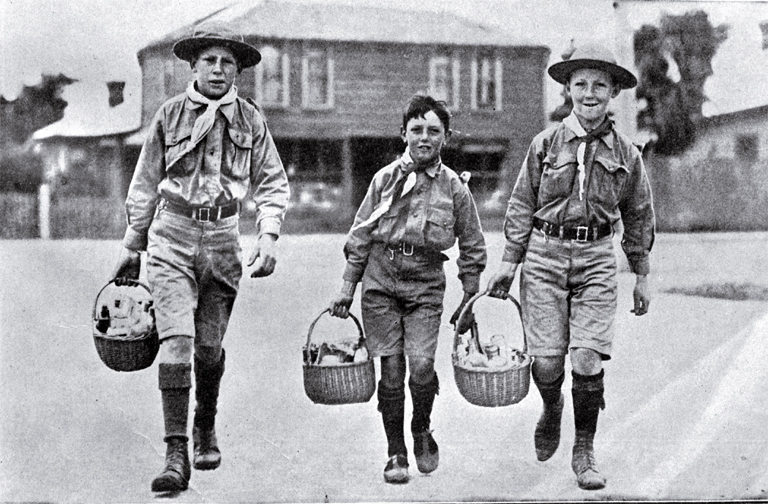
 Photo from Christ Church City Libraries website. Cheerful boy scouts acting as messengers to distribute food and medicine to patients at their houses during the influenza epidemic [1918] Pictured are: on the left John Neville Westgarth (d. 1981) and in the centre William Patrick (Bill) Sweeney (1908-1983).
I would not say I am a scout fanatic, but I do think the Boy Scouts of America have come up with some extremely amazing programs for youth. I do not know of a boy who would not benefit from the things learned and character gained from scouting. We have been involved in Cub Scouts since Josef was 8 years old. I have been a Den Leader for the Wolves, Bears, and Webelos and also served as Advancement Chairman and Cub Master over the last 5 years. Now Ian is a Cub and Josef has moved up to Boy Scouting-which is a whole thing for us. When the programs are run appropriately by trained leaders they can be so helpful to the development of these young boys.

I was thrilled to learn that Baden-Powell and Charlotte were changing the world at the same time.

Some quotes by Baden Powell:
"An individual step in character training is to put responsibility on the individual. "
"We never fail when we try to do our duty, we always fail when we neglect to do it. "
“The most important object in Boy Scout training is to educate, not instruct.”
“The boy is not governed by don't ,but is led by do.”
“Scoutmasters need the capacity to enjoy the out-of-doors.”

Did you catch the bits of truth shared between them? Many of their thoughts and philosophies were parallel and even Charlotte recognized Baden-Powell's potential to change the lives of children.

Quotes from When Children Love to Learn by Elaine Cooper page 30-

" It was typical of her open search for the best ideas to develop a full life that she pounced on Baden-Powell's Scout Handbook designed to train soldiers. I doubt that any other Victorian educators saw the potential in that book even for boys, let alone for the demure little girls with their governesses." 
" Charlotte not only saw potential in it, but she immediately purchased quantities of the handbooks and included them in the PUS (Parens Union School) curriculum."
" Thus while other children were kept indoors to have endless facts crammed into them, these fortunate children had every afternoon outside. One afternoon a week was for "scouting": tracking, noticing wind directions, learning to set up camp, and enjoying a truly hands-on education that thrilled and energized them. These children took part in the beginnings of the great scouting movement!"

Book Notes: When Children Love to Learn


"Miss Mason's educational philosophy is not about what someone thought as a Victorian; it is not tied to the the past, as if trying to hark back to a golden age. These ideas, being true ones, have an unchangeable underlying pattern (form) and yet give freedom for individual life and practice. When the Christin worldview gives this form, there is much stability and also freedom for appropriate adaptions. That is what makes this way of educating children so exciting. " ~When Children Love to Learn by Elaine Cooper page 25
I loved this thought from the book. It is so true. If you are using Charlotte's methods thinking you are recreating some bygone educational experience-like sleeping in an antique bed and breakfast- that is not what she ever intended. She believed that there were universal truths about children.That certain tried and tested practices helped children learn. She believed these could be applied to all children despite economic, cultural, and ethnic differences. The basic nature of children has not changed since Charlotte's day. We may add in new technologies and modern culture but this does not change the very nature of a child and how they learn.